
MENU
- Comprehensive Dispenser Manufacturer
- Recruitment Top
- Special Content
- Recruitment Team Roundtable Discussion
A roundtable discussion with HR staff.
Don't miss this honest talk about the employees who are thriving and the kind of people we want to work with.
Don't miss this honest talk about the employees who are thriving and the kind of people we want to work with.
Recruitment Team Roundtable Discussion
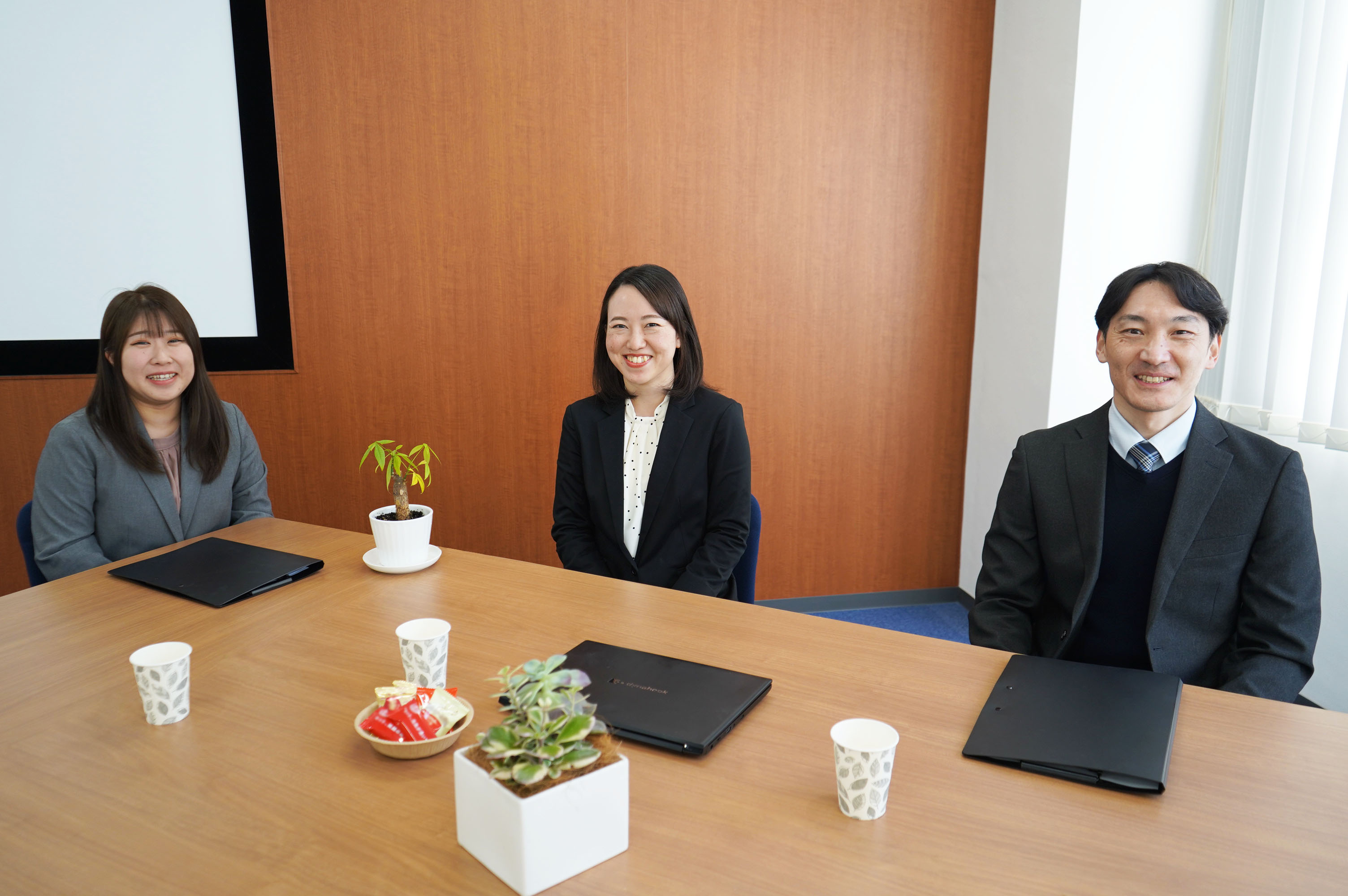

Members
- New Graduate Recruitment: S-san (Left)
- Education and Training: S-san (Center)
- Mid-Career Recruitment: C-san (Right)
What kind of people are thriving?
- C:
- First of all, a common trait is that they 'love manufacturing.' Even if they aren't well-versed in manufacturing, I feel that many people who have interest and motivation grow and succeed through their efforts after joining the company.
- S:
- That's true. Another thing is whether they are good at teamwork. Our work is almost never completed by one person alone. From the time a finished product reaches the user's hands, many departments such as the Sales Department, Engineering Department, and Manufacturing Department are involved, and close cooperation is required. People who can build relationships of trust with related departments and communicate closely tend to grow quickly.
- S:
- Honestly, I didn't know anything about dispensing technology until I joined Musashi, but it is a technology that can be applied to a truly wide range of fields. Nowadays, 'liquids' and our daily lives are inseparable. There must still be seeds that need our company's dispensing technology lying dormant everywhere. In that sense, people who possess a sharp 'perspective' to not overlook business possibilities and a 'challenging spirit' to boldly step into new areas also stand out.
- C:
- 'Love for manufacturing,' 'teamwork,' and 'challenge' are the three common traits of employees who are successful at our company.
This applies regardless of whether they are new graduates or experienced hires. I joined the company as an experienced hire myself. While specialized skills and experience from previous jobs are, of course, important for immediate contribution, I personally feel that these three common traits for success at our company are just as important.
- S:
- Certainly, I think that people with the common traits just mentioned are successful across the company as a whole, but I feel like there are differences depending on the job content.
What do you all think?
- S:
- That's true. Now that you mention it, I feel like there are slight differences depending on the job type.
In technical roles
- S:
- In terms of technical roles, while it goes without saying that they love manufacturing, many are also very particular about their work. For dispensers, for example, many have a desire to make it possible to achieve faster, more accurate, and more precise application with any material. There are many people who want to develop products that solve user problems and improve manufacturing in the world.
- S:
- Also, there are quite a few people who can (or want to) turn new ideas into reality without being bound by existing frameworks.
- S:
- We often call it "technology without a textbook" within the company. I talk to engineers often, and I hear that while repeating trial and error to derive the optimal solution is difficult, the sense of accomplishment is great.
In sales roles
- C:
- Next, how about sales positions?
- S:
- In our case, as a B2B manufacturer, our relationship with users doesn't end after a single interaction; we need to build a relationship of trust and continue providing long-term support. Since building trust is an important part of the job, many of them are good at empathizing with others and opening their hearts.
- S:
- Exactly, many people in sales are easy to talk to. I often consult with them regarding recruitment as well.
- C:
- Also, I think many people in sales don't feel much resistance to encountering the unknown. In fact, many are intrigued by new knowledge and stepping into unfamiliar industries. This is precisely because our technology can be applied in a wide range of fields.
- S:
- In our company, there are more sales employees with a liberal arts background than a science background. So, for those who like manufacturing or new things, I want them to take on challenges without being bound by fixed ideas.
- S:
- Also, there are many people with a liberal arts background in administrative positions as well. Administrative staff don't need specialized technical knowledge either; just like in sales, it's fine as long as you have an interest in manufacturing and a desire to support people. I also only learned about our company and dispensers for the first time when I was job hunting.
In manufacturing roles
- C:
- For manufacturing roles, there are many people who are dexterous and have good concentration. Also, my impression is that many have a craftsman-like spirit.
- S:
- In terms of personality, my impression is that many people work diligently and seriously. The manufacturing department as a whole has a calm and gentle atmosphere, but within that, communication is active, and there is a strong sense of unity.
- S:
- The difference from design, after all, is that you are directly touching things and giving them shape. People who enjoy working with their hands to create things—whether it's assembling dispensers or robots, or machining precision parts—tend to thrive here for a long time. That's why I get the impression that many of our employees have experience building robots in their student days or have hobbies like building plastic models; they enjoy working with their hands.

Musashi's Corporate Culture
- C:
- When working in HR, I'm often asked about the company culture, but honestly, it's one of the difficult questions to answer. So, shall we share what employees often say about the company?
- S:
- That sounds good. I often hear things like "there are strong connections between people," "there are many events, so you can become friends with people from different departments," and "the distance between employees is close regardless of their position." It might have something to do with us being a small-to-medium-sized manufacturer, but it might be a unique characteristic of our company that values a sense of unity.
- S:
- I often hear from engineers that the atmosphere is like a seminar or a research lab. I think this is a unique strength of our company, where people with different backgrounds gather and combine their expertise and skills to create products. Also, because the atmosphere is open, it is an environment where you can take on challenges if you actively speak up about what you want to do. I think it is a company where opportunities for growth keep coming to those who are motivated.
- C:
- Our company brings together a diverse group of people with rich personalities, including different characters, backgrounds, and values. Serious and quiet people, bright and energetic people, those with leadership skills, those who look around and focus on supporting others... One of the interesting things is being able to work with people who have ideas you have never encountered before.
- S:
- Regarding corporate culture, I don't think there is a good or bad one; it just depends on whether it suits a person or not. I would like to work with those who feel that this environment is a good fit for them after hearing this.
What We Value in Recruitment (Selection)
- C:
- Finally, what do you value in the recruitment and selection process?
- S:
- We look at whether they have at least one experience they can talk about with confidence. Since the dispenser industry is quite niche, almost no one, whether a career hire or a new graduate, joins us with prior experience or knowledge of dispensers. If they have at least one thing they can confidently say they are second to none in, or an experience where they overcame hardship to achieve something, I believe they can become a valuable asset through our training and education after joining the company.
- S:
- For students, I want them to have an experience they can talk about with confidence, whether it's academics, club activities, sports teams, part-time jobs, or anything else. I want them to appeal to us with the sense of accomplishment they felt from achieving something in their own way.
- C:
- Also, as I mentioned earlier, fitting into our corporate culture is important for long-term success. In this day and age, people have various ways of perceiving company events. But ultimately, to enjoy working for a long time, human relationships are important, and it comes down to whether they can empathize with that. It's not something you should force yourself to fit into, so I want people who can truly resonate with it to join us.
- S:
- It may sound cliché, but basic etiquette and manners, such as greetings, are also important. I want to work with people who can offer a cheerful and polite greeting in any situation.