

What is a dispenser?
We have compiled answers to frequently asked questions. Please use this to find basic information about dispensers and to resolve any questions you may have regarding our products and services.
For questions not listed below or for more detailed inquiries, please feel free to contact us via our website.
What is a dispenser?
Definition of a dispenser
A dispenser is a "tool for dispensing liquids" that can be seen in various situations, such as in daily life and industrial settings.
In fact, they are often used in daily life as well; "soap dispensers" for shampoo and conditioner, "drink dispensers" installed at drink bars in family restaurants for pouring beverages into glasses, and even "soft serve ice cream makers," which are now available for home use, are all types of dispensers.
A dispenser is a device that supplies liquids, pastes, etc., in fixed amounts, and there are various types. For example, they play an active role in various scenes of our daily lives and industries, such as cosmetics, food, chemical products, pharmaceuticals, and industrial products.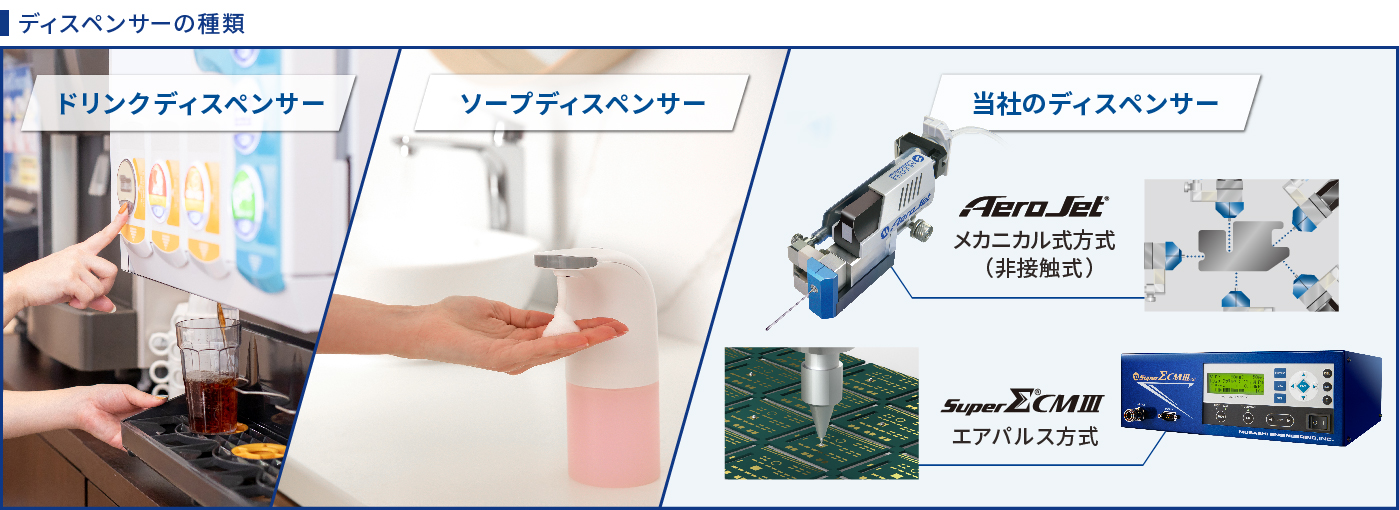
Our dispensers are classified as industrial dispensers among these, and they are developed and used to discharge liquid materials used in production sites such as factories in a "fixed quantity" and "precisely," and to "dispense" them into the required shapes.
The target liquid materials are diverse. Solder paste for electrically connecting parts, thermal interface materials for dissipating heat, and light-shielding ink for blocking light are some examples, and their hardness (viscosity) and curing conditions also vary.
We offer a lineup of various methods and types of dispensers so that these liquid materials can be dispensed according to our customers' various purposes, applications, environments, and conditions.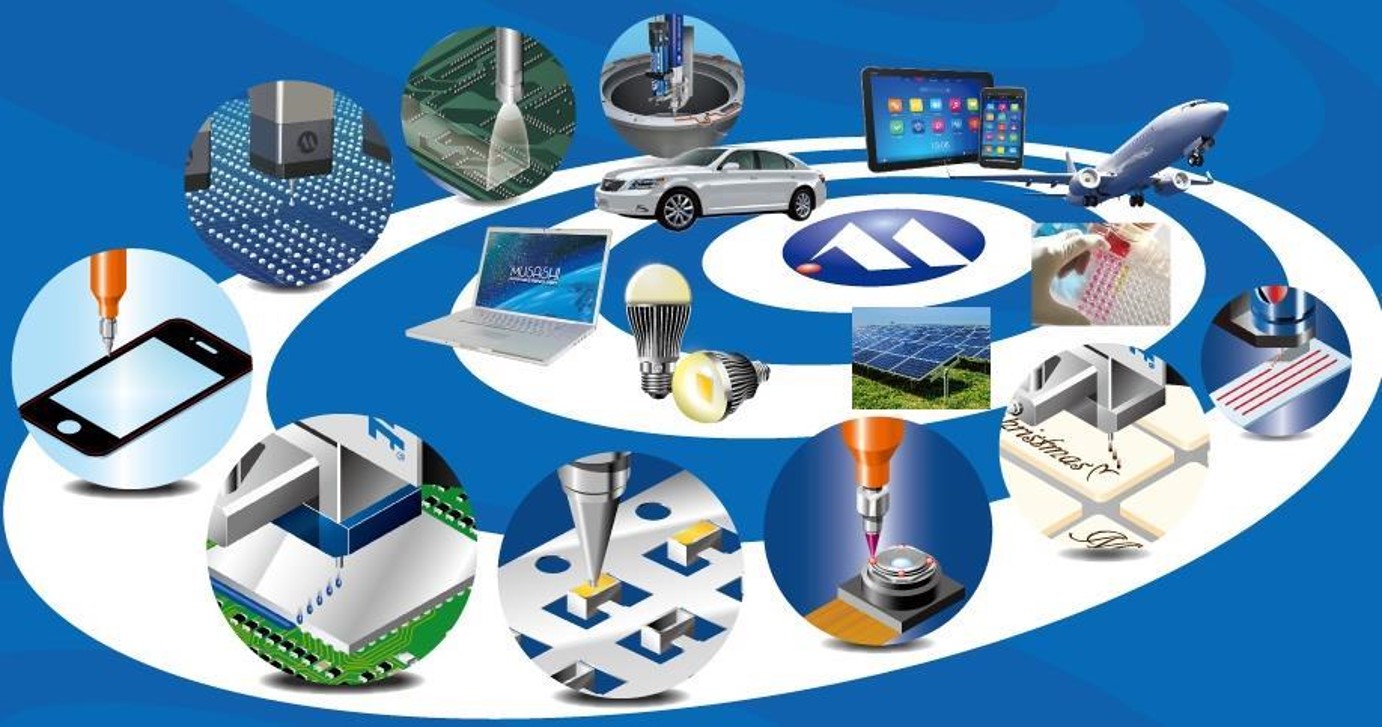
Dispensers active in various fields
Meaning and etymology of dispenser
The word "dispenser" is derived from the English word "dispenser." This word originates from the Latin "dispensare," which means "to distribute" or "to dispense." The Latin "dispensare" is further composed of "dis-" (to distribute) and "pendere" (to weigh), and originally referred to the act of dividing things equally.
The dispensers handled by our company mean "precision liquid control equipment" in Japanese, and refer to controllers and their peripheral devices that supply liquids with high precision and in fixed quantities.
Role and functions of a dispenser
One of the main roles of a dispenser is to supply liquid materials accurately and uniformly. By using a dispenser, work can be streamlined and product quality can be maintained in many situations, such as in manufacturing and chemical experiments.
For example, in the pharmaceutical industry, dispensers are used to accurately measure the amount of liquid medicine and fill various containers such as small vials. In cosmetics manufacturing, they are used to fill containers with a uniform amount of cream.
Furthermore, in manufacturing industries such as the automotive, electrical, and electronics industries, they are used to dispense liquid agents like adhesives, lubricants, and thermal interface materials accurately and with high precision at a set discharge volume. They play a very important role not only in improving product quality but also in standardizing manufacturing processes and achieving mass production.
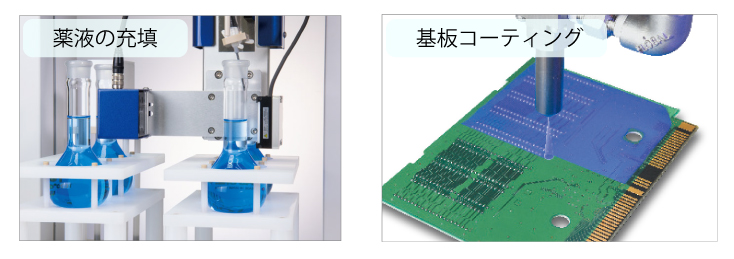
Examples of dispenser applications
Evolution through technological innovation
Dispensers have evolved significantly in various technologies, such as dispensing precision and speed. With the introduction of new technologies, more accurate and efficient dispensers have been developed, further advancing the automation of conventional manual work. For example, in the smartphone production process, as products become smaller and more high-performance, there is a demand for highly precise, extremely minute dispensing that is difficult to perform manually.
At Musashi Engineering, we focus our efforts on technological development to meet such stringent dispensing requirements, and in micro-dispensing, we possess precise dispensing technology capable of non-contact dispensing of Ag paste with a diameter of 110μm onto a grain of rice (approx. 5mm).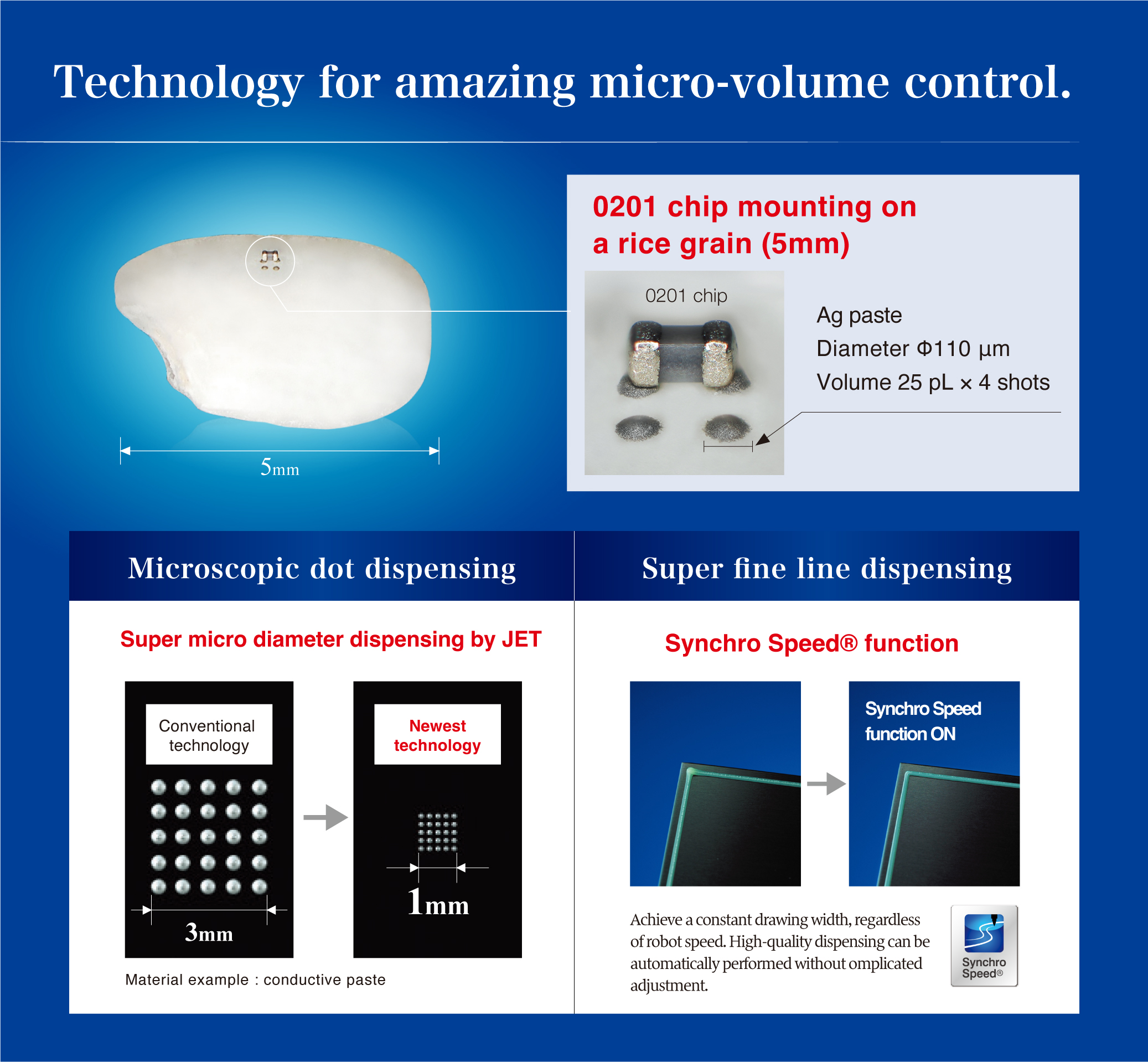
Cost reduction and environmental considerations
Since dispensers have the function of controlling the dispensing amount according to the required quantity, they can reduce material waste. Furthermore, accurate dispensing improves product quality and can prevent the occurrence of defective products.
Consideration for the environment is also an important point. By using a dispenser, it is possible to suppress excessive material usage and reduce waste, thereby realizing resource conservation and a reduction in environmental impact. In addition, the latest dispensers can reduce energy consumption across the entire manufacturing process by improving energy usage efficiency through features such as energy-saving modes. Furthermore, dispensers capable of using environmentally friendly materials, such as solvent-free coating materials, have also been developed, allowing products to be manufactured while minimizing negative impacts on the environment.
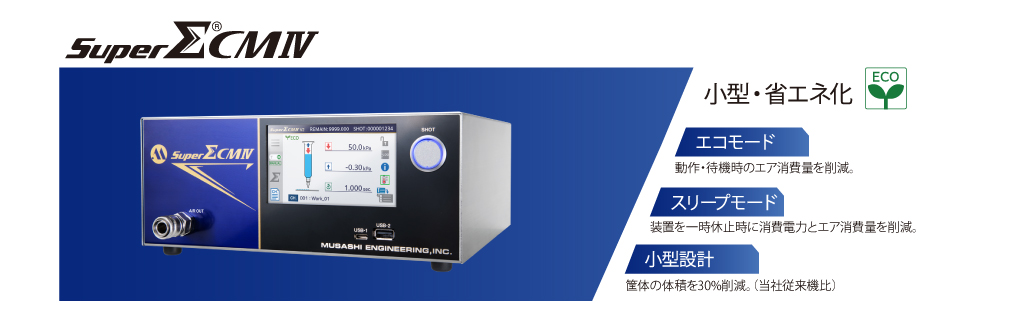
Musashi Engineering's dispensers
At Musashi Engineering, we handle various types of industrial dispensers, including air pulse, jet, and volumetric metering systems. For more information on the types of dispensers, please check the link below.
>[Q&A] What types of dispensers are there?
Other recommended links
>[Q&A] Can dispensers be mounted on robots?
> Musashi Engineering's Strengths
>[Product List] Dispensers
Download Catalogs and Software
Login registration to this site is required for downloads.




Contact Us