

Basic Knowledge of the Underfill Process and Requirements for Dispensers


About this article
Underfill is a critical process that supports the reliability of semiconductor packaging.This article explains the basic role of underfill, the causes of common defects during assembly and their countermeasures, and key points for achieving high-precision dispensing.
- 1st Level Underfill (1st Level UF)
- - Purpose of 1st Level Underfill
- - Market trends for 1st Level Underfill
- - Types of 1st Level Underfill methods
- - Dispensing requirements for 1st Level Underfill and challenges for dispensers
What is underfill?
Underfill is a process of filling the gap between a chip and a substrate with resin (underfill material) and curing it to reinforce and protect the joint.
When electronic devices are subjected to heat or shock, areas prone to stress, such as solder joints (metal that conducts electricity), can be damaged, leading to breakage or connection failures.
Underfill is one of the technologies used to prevent such risks and improve product reliability.
Example of an underfill process
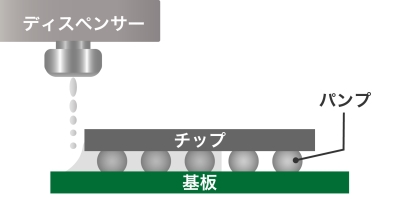
(1) Dispensing of underfill material

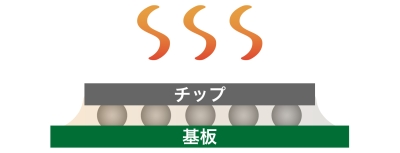
(2) Curing the resin by heating

(3) Completion
1st Level Underfill (1st Level UF)
This is the process of filling the gap created when a semiconductor chip (bare die) is bonded to a substrate or interposer via bumps with resin. The gap is extremely narrow, measuring only a few tens of μm, requiring ultra-precise dispensing at the micron level.
Purpose of primary underfill
- Reliability improvement
Mitigation of thermal stress on bumps and prevention of joint defects due to differences in thermal expansion - Failure prevention
Prevention of short circuits during secondary reflow when mounting to the motherboard - Ensuring heat dissipation
Increasing demand for CPO/co-packaged optics, stacked dies, etc.
【Co-packaged optics】Learn more about CPO
CoW
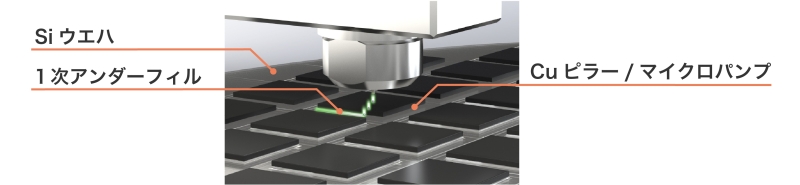
Market trends for primary underfill
・ Diversification of packages due to the advancement of interconnect technology
(thin flip-chip, chiplet, SiP, 3D stacking, etc.)
・ Narrowing of the bonding gap between chip and substrate and finer pitch
Types of primary underfill methods
① CUF (Capillary Underfill)
Filling resin from the chip edge via capillary action
② MUF (Molded Underfill)
Simultaneous underfilling and encapsulation with mold resin
③ NUF (Non-Flow Underfill) / NCFF
Apply resin/film before chip mounting
Primary underfill application requirements and challenges for dispensers
| Dispensing requirements | Challenges for dispensers | |
|---|---|---|
| ① Minimization of dispensing volume due to narrower gaps | ▶ | Micro-dispensing control |
| ② Prevention of resin climbing (chipping/adhesion to top surface) due to thinner chips |
▶ | Micro-dispensing and high-precision position control |
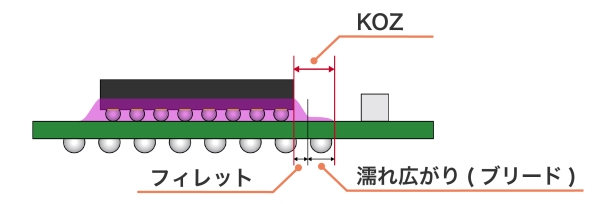
| ③ Higher density due to SiP/chiplet integration | ▶ | Support for narrow KOZ (Keep Out Zone), high-precision drawing, and high-speed response |
KOZ (Keep Out Zone)
2nd Level Underfill (2nd Level UF)
This is an encapsulation process used to reinforce a completed semiconductor package (such as a BGA) after it has been mounted onto a product's main board (motherboard). This also includes "corner bonding," where only the four corners are secured as a countermeasure against drop impacts for devices like smartphones.
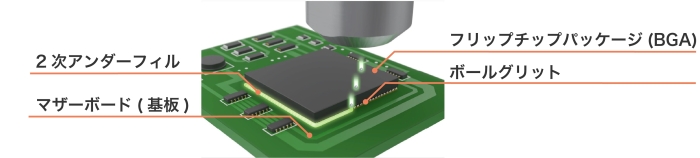
Purpose of secondary underfill
- Prevention of BGA (Ball Grid Array) breakage due to drop impact and mechanical stress
Mitigation of thermal stress on bumps and prevention of joint defects due to differences in thermal expansion - Suppression of package deformation and solder strain due to heat cycles (differences in thermal expansion)
Market trends for secondary underfill
・ Increase in I/O count due to package functional improvements・ Narrowing of ball pitch
・ Establishment of high-density bonding from lead frames to BGA/LGA, etc.
・ Progress in high-density board mounting due to the higher functionality and miniaturization of various electronic devices
Types of secondary underfill application methods
① CUF (Capillary Underfill)
Resin filling under the entire package
② Edge Bond
Resin application reinforcement to the package periphery (each side) (easy visual inspection)
③ Corner Bond
Resin application reinforcement to the four corners of the package (reduced application amount, easy visual inspection)
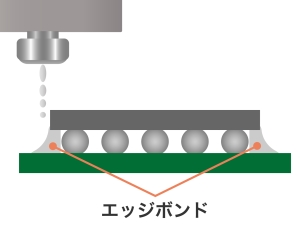
Application requirements for secondary underfill and challenges for dispensers
| Dispensing requirements | Challenges for dispensers | ||
|---|---|---|---|
| (1) | Prevention of adhesion to surrounding components in high-density mounting | ▶ | High-precision positioning and suppression of landing variation (flight control) |
| (2) | Prevention of resin climbing (chipping/top surface adhesion) associated with thinning chips |
▶ | Special workpiece approaches such as angled dispensing |
Requirements for dispensers
As advanced packaging progresses for both primary and secondary underfill, the need for our core technologies that support the following is expanding:
- Micro-dispensing volume control technology
- High-precision dispensing position and flight control technology
- High-speed, high-precision motion control technology
Dispensing solutions for the underfill process
Musashi Engineering possesses long-cultivated know-how in underfill application.
In line with the requirements for underfill application in cutting-edge technologies such as advanced semiconductor devices and photoelectric fusion devices, we leverage our micro-dispensing volume control and high-precision motion control technologies to provide optimal solutions for the underfill process.
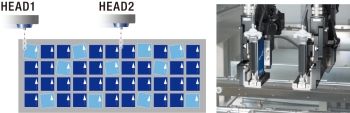
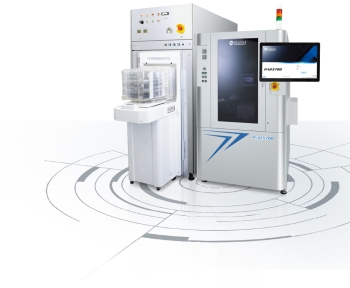
Achieving both high productivity and dispensing accuracy with 2 heads
MUSASHI's FA flagship model
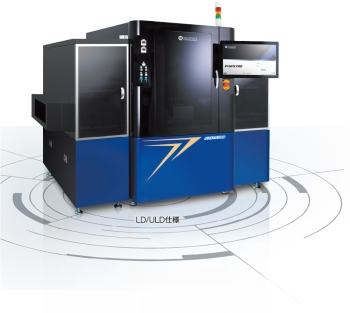
01 Micro-dispensing (SuperJet + high-precision positioning)
Capable of dispensing at the industry's highest level of KOZ
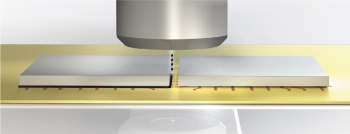
02 Multi-head independent control allows for flexible control of
dispensing positions
03 User-friendly

- The latest UI guides you to the next operation, making it easy for anyone to use.
- Offline tools allow for recipe registration without stopping production.
An integrated solution that opens a new era of wafer processing
Remapping of production and fillet inspection results with wafer mapping-compatible software
(SECS/GEM compliant)
 ▶ Visit the special site "Dispense Solutions for Post-Board Assembly Processes"
Recommended Catalogs
Fully automatic dispensing system
Fully Automatic Dispensing Equipment Catalog

FAD5700

Summary
Underfill is a critical process that influences the quality and product life of semiconductor mounting. To suppress defects, it is important to consider the appropriate application method for the required application specifications. Addressing these challenges, we propose optimal dispensing systems by leveraging our experience contributing to the market over many years.
If you have any questions regarding underfill or side-fill application processes, or the selection of dispensers and equipment, please feel free to contact us.
Glossary of Underfill Terms
・ Capillary action
A phenomenon in which liquid is naturally drawn into narrow spaces, such as thin tubes or gaps.
▶ Return to main text・ Fillet
This refers to the rounded surface of a liquid as it follows the walls or corners of a container. In underfilling, it serves as an indicator of whether the resin has reached the edges.

・ Reflow
This is a heating process in which electronic components are mounted and fixed to a circuit board by melting solder and then cooling it to solidify.
Learn more about reflow・ Wettability
This is a property indicating the degree of affinity (ease of spreading) of a liquid when it comes into contact with a solid surface.
FAQ