

Improve Dispensing Accuracy with Temperature Control Equipment! The Role of Temperature Control in Dispensers


About this article
This article explains the effects of temperature control equipment on liquid dispensing, as well as the features and selection points for heating-type and Peltier-type temperature control.- What can temperature control equipment do?
- Features of heating-type temperature control
- Features of Peltier-type temperature control
- (1) Improve discharge accuracy by keeping the liquid temperature constant
- (2) Manage the liquid temperature lower than the ambient temperature to suppress changes in the state of the liquid
- Disadvantages of Peltier-type temperature control
- Advantages of Peltier-type temperature control
- Musashi Engineering's Peltier-type temperature control
- Musashi Engineering's air-pulse dispenser with integrated Peltier-type temperature control
- If you want to minimize the impact of "changes in liquid viscosity"
- Key points for product selection
- Recommended Catalogs
Improve Dispensing Accuracy with Temperature Control Equipment! The Role of Temperature Control in Dispensers
Equipment for adjusting the temperature of liquid materials is referred to by various names, such as heating systems, temperature control units, constant temperature control systems, and heating/temperature control systems. At our company, products called "Temperature Control Blocks" and "Temperature Control Controllers" fulfill this role. We will explain the role these temperature control devices play.
Temperature Control Connection System Configuration Diagram

What can temperature control equipment do?
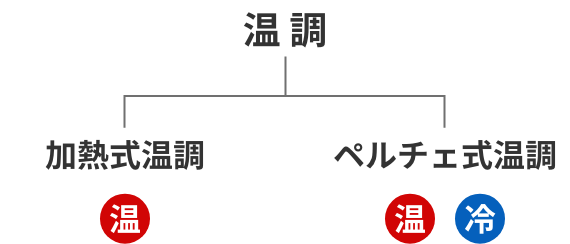
First, our temperature control devices are broadly divided into "heating-type temperature control" and "Peltier-type temperature control."
"Heating-type temperature control" is used for the purpose of raising the temperature of the liquid material. On the other hand, "Peltier-type temperature control" can both raise and lower the temperature, so it is used for the purpose of maintaining the liquid material at a target temperature.
How the Peltier method works
A Peltier element has the characteristic (Peltier effect) that when an electric current is applied, one side is cooled (heat absorption) and the other side is heated. Utilizing this characteristic, a temperature control method that cools or heats the area around the syringe is called Peltier-based temperature control. Especially when cooling the syringe, it is necessary to effectively dissipate the heat generated on the opposite side, so fans or air are used.

Features of heating-type temperature control
There are two main purposes for using heating-type temperature control, as described below.
(1) Lower the viscosity of the liquid to improve discharge performance
(2) Resolve discharge issues caused by low ambient temperatures
➀ Lower the viscosity of the liquid agent to improve dispensing performance
When dispensing high-viscosity liquid materials, it may take time to dispense them as they are, or it may not be possible to apply them in the intended amount or shape. Heating-type temperature control effectively lowers the viscosity by appropriately warming the liquid material, making it easier to dispense.
 Also effective in reducing stringing
The "stringing" that often occurs when dispensing liquid agents is also, in many cases, related to viscosity. If the viscosity is too high, it becomes difficult for the liquid to cut off cleanly when dispensing ends, making the phenomenon of drawing a thin thread more likely to occur. By appropriately adjusting the viscosity through heating, this stringing can be suppressed, and the risk of defects in subsequent processes can also be reduced.
(2) Resolve discharge issues caused by low ambient temperatures
"It dispensed without any issues in the test environment, but for some reason, it doesn't work well on the actual production floor..." In many cases, environmental temperature has a significant impact on the background of such troubles. Especially in winter or in cold regions where the ambient temperature of the site is low, the viscosity of the liquid agent increases.
By introducing a heating-type temperature control system, it becomes possible to keep the liquid agent at a constant temperature regardless of the ambient temperature of the site. As a result, stable dispensing performance can be maintained regardless of the season or location, leading to improved productivity and stabilized quality.
Disadvantages of heating-type temperature control
- Heat-sensitive liquid agents may be adversely affected by heating
- Since there is no cooling function, the temperature of the liquid agent cannot be lowered below the ambient temperature
Advantages of heating-type temperature control
- Due to its simple structure, maintenance is easy and the risk of failure is low.
- Relatively low introduction cost.
Musashi Engineering's heating-type temperature control

Features of Peltier-type temperature control
The greatest advantage of a Peltier-type temperature control system is that it possesses both "heating" and "cooling" functions.
The main purposes for using Peltier-type temperature control are the following two.
(1) Improve discharge accuracy by keeping the liquid temperature constant
(2) Manage the liquid temperature lower than the ambient temperature to suppress changes in the state of the liquid
(1) Improve discharge accuracy by keeping the liquid temperature constant
The room temperature of a production site is constantly changing depending on the season, time of day, and the presence or absence of air conditioning equipment. This change in room temperature affects the temperature of the liquid agent itself and causes fluctuations in viscosity. For example, if the room temperature rises, the viscosity may decrease, potentially increasing the dispensing amount. Conversely, if the room temperature drops, the viscosity may increase, and the dispensing amount may decrease. In response to such changes in the external environment, the Peltier type enables precise temperature maintenance with an integrated heating and cooling unit.
Furthermore, in addition to the influence from the external environment, a major feature of the Peltier-type temperature control with a cooling function is that it is also effective against heat generation inside the syringe (e.g., chemical reaction heat of adhesives, etc.).
(2) Manage the liquid temperature lower than the ambient temperature to suppress changes in the state of the liquid
Disadvantages of Peltier-type temperature control
- The upper limit of the adjustable temperature range is low.
Advantages of Peltier-type temperature control
- Precise temperature maintenance through an integrated heating and cooling system.
Musashi Engineering's Peltier-type temperature control
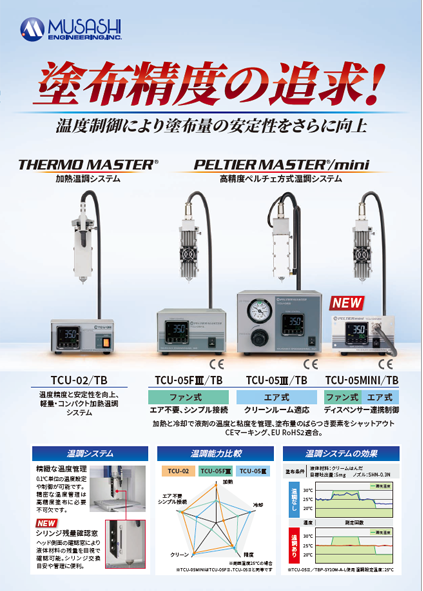
The fan-cooled type can be used with just a power supply, but if you are concerned about dust generation from the fan, such as when using it in a clean room, please consider the air-cooled Peltier temperature control unit.
The TCU-05MINI is a new temperature controller that supports both fan-cooled and air-cooled blocks.


Musashi Engineering's air-pulse dispenser with integrated Peltier-type temperature control
The following integrated temperature-controlled dispensers have a built-in temperature controller, allowing for temperature management via the dispenser's settings screen. (Temperature control blocks and temperature control cables are sold separately.)
Temperature Control Connection System Configuration Diagram (Peltier-based Temperature Control Integrated Type)


Full-Function Digital Control Dispenser SuperΣCMⅣ Pro
A high-end model equipped with Σ3 major functions and temperature control functions.

Air Pulse Dispenser with Built-in Temperature Control CTR ML-7000X
Space-saving design that consolidates the space for two units into one. Settings for dispensing and temperature control are also easy.

If you want to minimize the impact of "changes in liquid viscosity"
Volumetric Dispenser MPP Series
We recommend the Volumetric Dispenser MPP Series.
The MPP series is a dispenser characterized by its "quantitative accuracy," which is less susceptible to changes in liquid viscosity.
Even if the "viscosity" of the liquid changes, the "volume" dispensed remains constant, allowing for stable and precise dispensing.
Since the dispensing amount is controlled by the plunger's travel distance, it dispenses a constant amount regardless of the liquid viscosity.

Utilizing the MPP Series: Addressing factors other than viscosity changes due to temperature
Viscosity changes due to temperature are not the only cause of variations in dispensing volume. For example, slight variations in liquid viscosity can occur each time the liquid lot (manufacturing number) changes.
Example of variations between liquid lots

Even in cases where the dispensing volume fluctuates due to such "variations between liquid lots," the MPP series, which accurately measures the volume of the liquid, proves effective. Because it always dispenses a set constant volume regardless of differences in liquid viscosity between lots, it is possible to maintain a stable dispensing volume.
Disadvantages of the MPP Series
- It takes time to fill the liquid at certain intervals.
Advantages of the MPP Series
- Less susceptible to both "changes in liquid viscosity" and "viscosity variations between liquid lots."
- Compatible with a wide range of liquid viscosities.
- High dispensing stability.
Musashi Engineering's Volumetric Dispenser: MPP Series

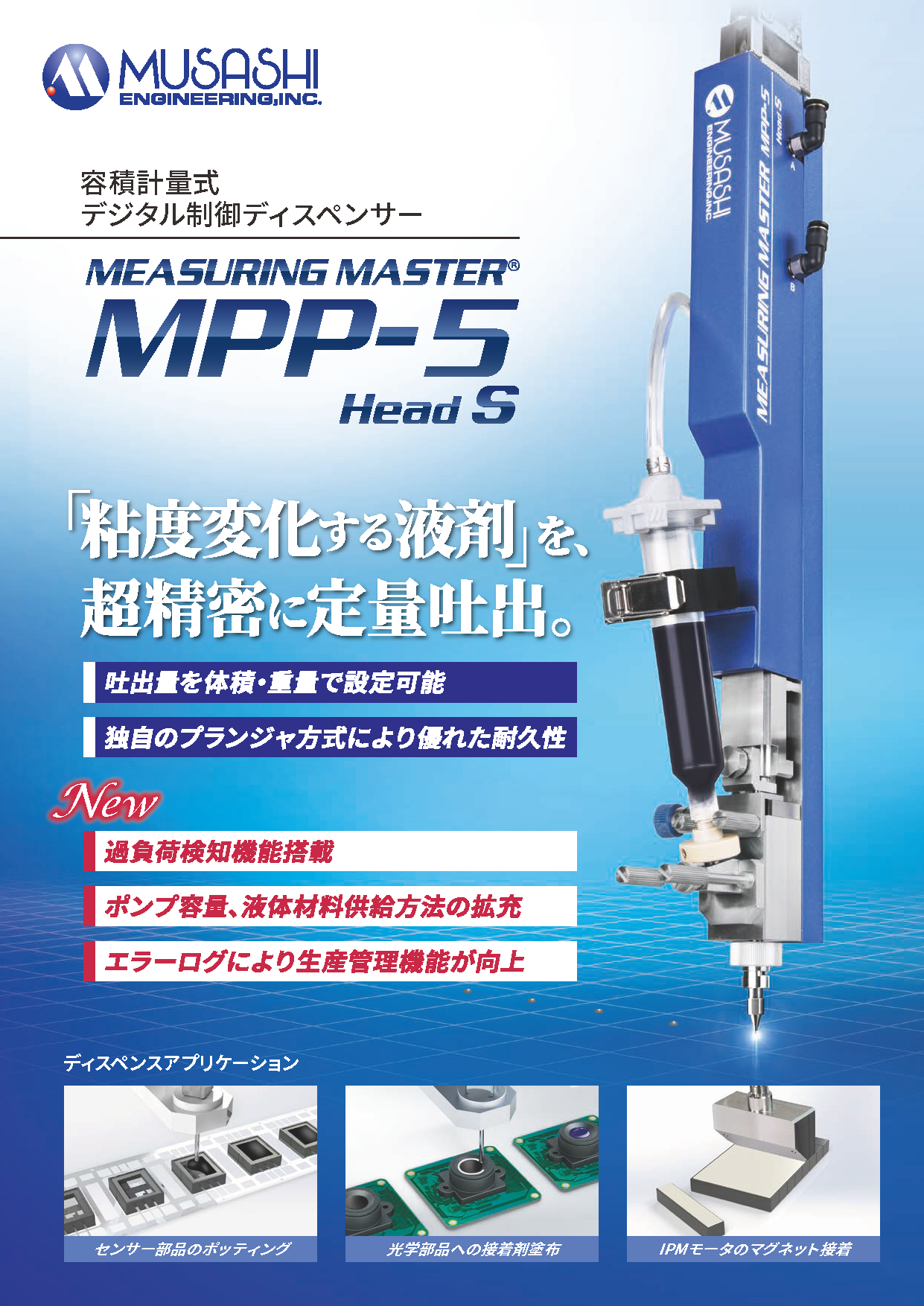
Volumetric Digital Control Dispenser MEASURING MASTER MPP-5-S
Maximum dispensing volume
approx. 0.5 mL

Large-Capacity Volumetric Digital Control Dispenser MEASURING MASTER MPP-5-M
Maximum dispensing volume
approx. 7 mL
Key points for product selection
When selecting a product, it is important to consider the following points. Based on these, you need to choose the optimal product.
- Liquid characteristics: Consider the viscosity of the liquid used, the effects of temperature changes, and the impact of heating or cooling on the liquid.
- Installation environment: Consider changes in room temperature, operating heat generated by the equipment, and the space available at the installation site.
- Production line requirements: Consider the required dispensing accuracy, stability of the amount, and constraints of the containers used.
- Cost aspects: Consider initial installation costs, running costs for operation, and the ease and frequency of daily maintenance.
It is important to comprehensively judge these factors and select the product that is optimal for your application and environment.
Solve dispensing challenges with Musashi Engineering's dispensing solutions
In the liquid dispensing process, issues such as "unstable discharge volume," "quality variations," and "maintenance burden" are critical problems that directly impact production efficiency and product quality.
We propose optimal solutions tailored to your specific situation, addressing factors such as changes in liquid viscosity, the influence of ambient temperature, variations between liquid lots, and demands for high-precision dispensing.
With our diverse product lineup, we can flexibly respond to your various needs, so if you are currently having trouble with liquid dispensing or application, please feel free to consult with us.
Recommended Catalogs
Peripheral equipment and accessories
Heater-based Temperature Control / Peltier-based Temperature Control
PELTIER MASTER
THERMO MASTER
Dispenser
Peltier-based Temperature Control Integrated Air Pulse Dispenser
SuperΣCMⅣ Pro

ML-7000X

Volumetric Dispenser MPP Series
MPP-5-S
MPP-5-M