

How to Choose Dispenser Syringes (Industrial Syringes) | Key Points to Avoid Mistakes


About this article
In the dispensing process, the selection of the syringe significantly affects dispensing accuracy and work efficiency. This article explains the key points for selecting the type and capacity of syringes, taking into account the properties of the liquid material and the usage environment.- Key points for selecting the type of syringe
- ・Properties of the liquid material
- ・Operating temperature range
- ・Prevention of operational errors
What is a syringe? Why selection is necessary
The syringe used in the dispenser application process is a container for holding and applying liquid materials such as adhesives, solder paste, and grease. Since compatibility with liquid materials and handling requirements vary depending on the syringe, selecting the appropriate one for your application and conditions can lead to improved application accuracy and work efficiency.
Common concerns when selecting a syringe

To solve these concerns, we will explain the key points to keep in mind in order.
Key points for selecting the type of syringe
The standard for selection is the clear syringe, which is the most inexpensive and versatile.
If there are special requirements, choose the optimal type based on the following three points.

Characteristics of liquid materials
For UV-curable materials, UV block syringes that can block ultraviolet rays are suitable. Another feature is that it is easy to visually check the remaining amount.
Also, if you are handling materials that cannot be used with resin, stainless steel syringes are suitable.


Operating temperature range
For materials used by heating, such as hot melts and waxes, heat-resistant syringes are effective. As a guide, use heat-resistant resin syringes for temperatures up to 130°C or 180°C, and stainless steel syringes for high-temperature conditions up to 200°C.


Prevention of operational errors
In workplaces that handle multiple liquid materials, color syringes are useful for product management and preventing mix-ups. By using them in combination with clear syringes or UV block syringes, it becomes easier to identify them, which leads to the prevention of operational errors.
Key points for selecting the syringe size (capacity)
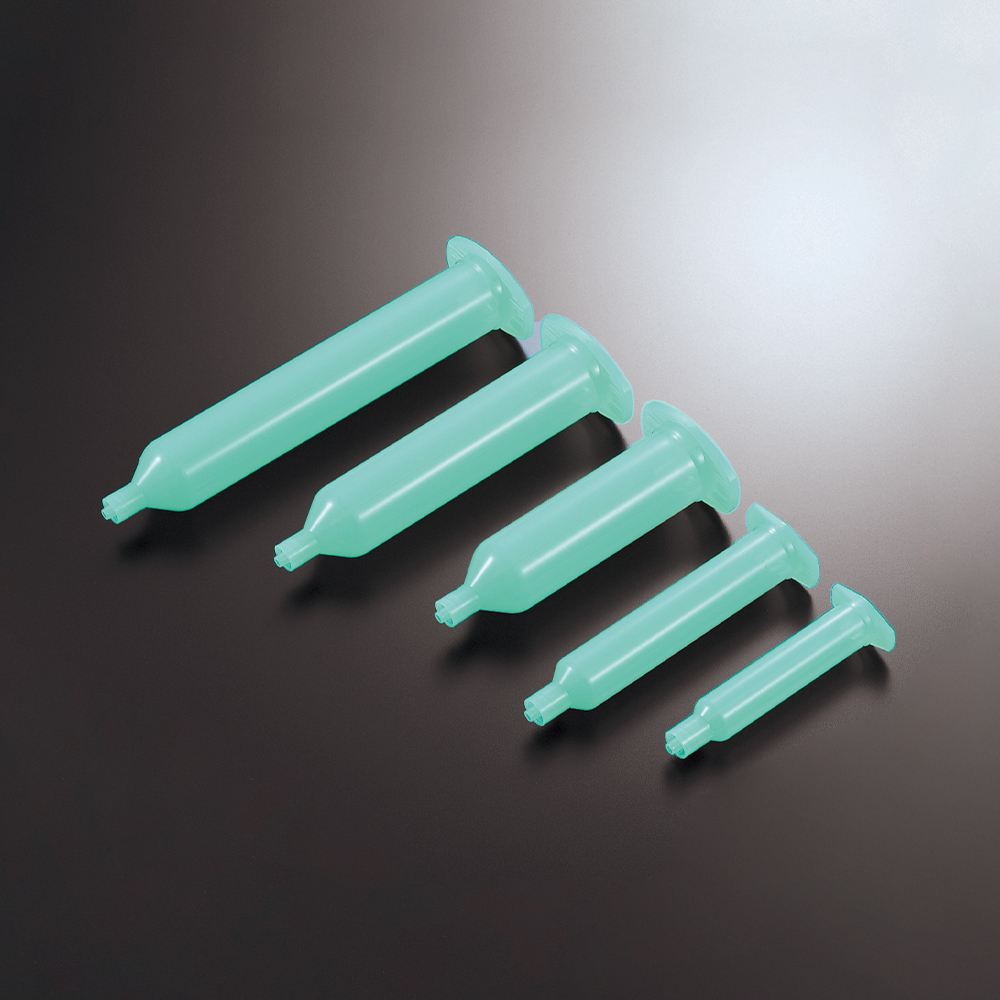
When deciding on a syringe size, a large-capacity type is sometimes chosen to reduce the frequency of material replacement and replenishment. However, bigger is not always better, and a small-capacity type may be more suitable depending on the application and usage conditions.
Here, we will explain five points for choosing the optimal size.
Pot life (usable time)
If the material filled in the syringe exceeds its pot life, it must be discarded to maintain quality. Considering the amount applied per application and the production quantity, choosing a capacity that can be used up without waste within the time limit leads to cost reduction.
Influence of head difference (liquid level height)
In air-pulse dispensers, the larger the syringe capacity, the greater the change in head pressure. Therefore, in the process of using a single syringe, a difference in the application amount is likely to occur between the first half and the second half. It is important to determine the appropriate capacity rather than using a syringe that is larger than necessary.
The effects of head pressure and correction methods are explained in detail in the following article.
▶ Related article: Challenges and solutions for air-pulse dispensers! What are the 3 major Σ functions that solve dispensing problems?Dead volume (residual liquid)
Small-capacity syringes tend to have less dead volume when scraped off by the plunger, which leads to a reduction in material loss. This is a particularly important point when using expensive materials such as precious metal pastes.
Installation conditions
Depending on the size of the syringe, it may interfere with peripheral equipment such as dispensers. Since custom designs may be required in some cases, it is necessary to check the space on the equipment side in advance.
Ease of manual handling
In manual application, the ease of holding and the weight of the syringe affect workability. Also, since a high workload can affect application accuracy, it is required to choose a size that is easy to handle.
Summary
Choosing a syringe is not just about selecting a container; it is a process that directly affects application accuracy, material costs, and work efficiency. It is important to select the optimal type and capacity by considering material properties, temperature, pot life, etc., while taking into account common selection mistakes.
The features and types of dispenser syringes we handle are introduced in the following article.
We also accept consultations on selection according to your application and materials, so please feel free to contact us if you have any questions.
Recommended Catalogs
Parts Catalog
Parts, Accessories & Valves/Tanks Catalog

Syringe
Clear Syringe

UV Block Syringe Barrel

Anti-Static Syringe

Heat-Resistant Syringe (180°C)

Heat-Resistant Syringe (130°C)

Peripheral equipment
MIX MASTER

Simple syringe filling machine

AWATRON3